Cupping, Crowning and Buckling
Cupping happens when the bottom of a board holds more moisture than the top, so the edges lift and the middle dips. Crowning is the opposite, with the center higher than the edges, and it often appears after a cupped floor is sanded too early. Buckling is the most serious, when boards lift off the subfloor.
Each shape tells you something about where the moisture came from. Cupping usually points to water below or humidity trapped under the floor, while a spill on the surface tends to leave stains and finish damage.
| Symptom | What it suggests | First step |
|---|---|---|
| Edges of boards rise, center dips | Moisture from below or a slow leak | Find the source and take moisture readings. |
| Center of boards rises | Over-drying or sanding a cupped floor too soon | Let the floor stabilize before judging. |
| Boards lift off the subfloor | Heavy water exposure | Stop the water and call for drying. |
| White haze or dark stains | Surface moisture, finish damage | Dry the area and assess the finish. |
Common Causes in Homes
The causes that come up most are a washing machine valve failure, a dishwasher line leak, a refrigerator ice maker line and an air conditioner condensate drain that overflows. Plumbing under the floor can leak for weeks before the floor shows it.
One scenario is a condensate line that backs up and slowly wets the flooring and subfloor near the air handler. The floor cups gradually, and the cause is only found when someone checks the line.
How Wood Floors Are Dried
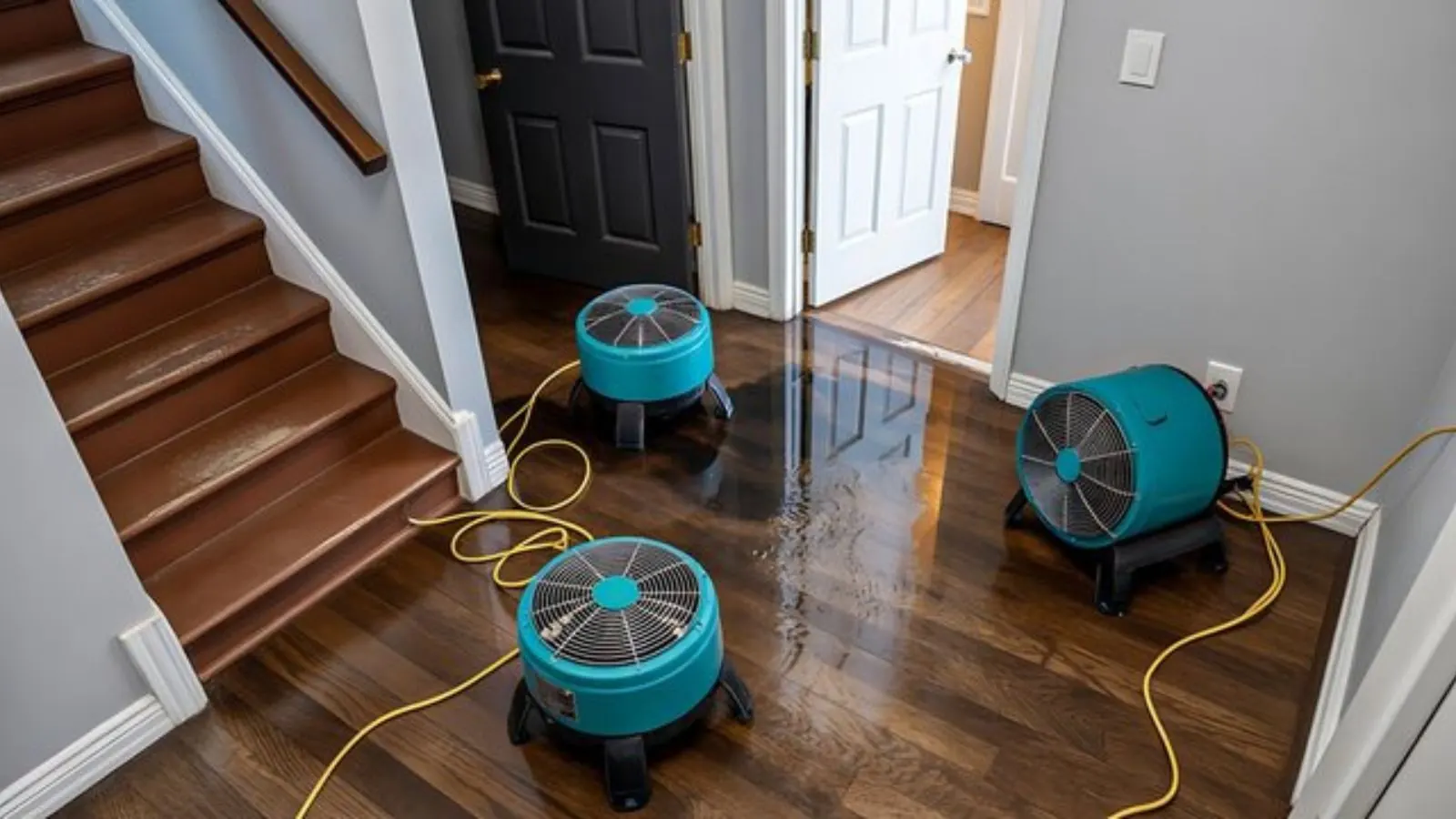
A crew starts by finding and stopping the source, then maps moisture in the boards and the subfloor with a meter. Specialty drying mats or panels pull moisture from the top while air movers and dehumidifiers control the room. Some floors are dried with the finish on, and others need a few boards removed so air can circulate underneath.
Readings are taken each visit. The goal is to bring the wood back to the moisture level of an undamaged section of the same floor, which can take several days. Rushing the process or heating the room too much can crack the boards.
What Not to Do
- Do not sand or refinish while the floor is still above its target moisture.
- Do not cover wet flooring with rugs or plastic that trap moisture.
- Do not crank a space heater at the floor, since fast drying can split boards.
- Do not assume a floor that feels dry on top is dry underneath.
When Replacement Is the Answer
If boards remain badly warped after drying, if the finish has failed across the room or if the subfloor is damaged, replacement is the better call. Repairs that restore only part of a room often leave a visible mismatch, so crews and flooring contractors discuss how far to go.
After drying, water damage repair handles replacing boards, repairing the subfloor and refinishing. Pricing follows the area, the species and the thickness of the wood.
Solid Wood, Engineered Wood and Laminate
Solid hardwood is a single piece of wood, so it can often be sanded more than once and may recover after drying. Engineered wood has a thin wear layer over plywood or composite, so there is less to sand and the layers can separate when wet. Laminate is a photo layer over fiberboard, and water that reaches the core usually swells it for good.
Knowing which you have changes the plan. Check the edge of a board at a vent or doorway, or ask the installer or previous owner. A crew can usually identify the type in a minute.
The Timeline of a Wet Floor
- Day of the leak: stop the water and remove standing water.
- First days: drying mats and air movers pull moisture from the boards, and readings are taken daily.
- After drying: the floor is allowed to settle, since boards move for a while as moisture equalizes.
- Final decision: sand and refinish if it is flat, or replace the sections that did not recover.
Patience at the end matters. Sanding a floor that has not stabilized is the most common reason for a repair that looks fine for a month and then fails.
Protecting a Floor During a Leak
Lift furniture legs onto foil or plastic blocks so stain from wet wood feet does not set. Remove rugs, blot standing water and keep foot traffic off swollen boards, since walking on them can chip the finish and crush wet edges.
Questions for the Flooring Contractor
- Is the moisture reading now equal to an unaffected area?
- Will the new boards match the old species and width?
- Do you plan to refinish the whole room for a consistent look?
- How long will the floor acclimate before installation?
Good answers show that the contractor is planning around the wood, not just the schedule.
Bellflower Local Note: Permits and Who to Call
The City of Bellflower's permit handout lists plumbing, water heater and electrical work as needing permits and does not address flooring. Call the city at (562) 804-1424, extension 2006, before a large replacement to confirm what is needed.
Bellflower is served by four water companies, so if the floor is damaged by a supply leak, check which one owns your meter before you shut off. The same pattern applies across the border in Lakewood and Cerritos, where cities run their own water utilities.
Wood Floor Water Damage FAQ
Sometimes, if the moisture source is gone and the floor is dried slowly. A moisture reading tells you whether it is still wet.
It depends on the species, the thickness and how deep the water went. Several days is common, and the readings decide.
The city's handout does not address flooring. Ask Bellflower building staff at (562) 804-1424, extension 2006, before work begins.
Not always. A crew can often dry in place, but they will remove boards when trapped moisture requires it.
Yes. It has a thinner top layer over plywood or composite and responds differently, so drying and sanding limits differ.
If the floor was soaked by a leak, water mitigation is the step that comes first.